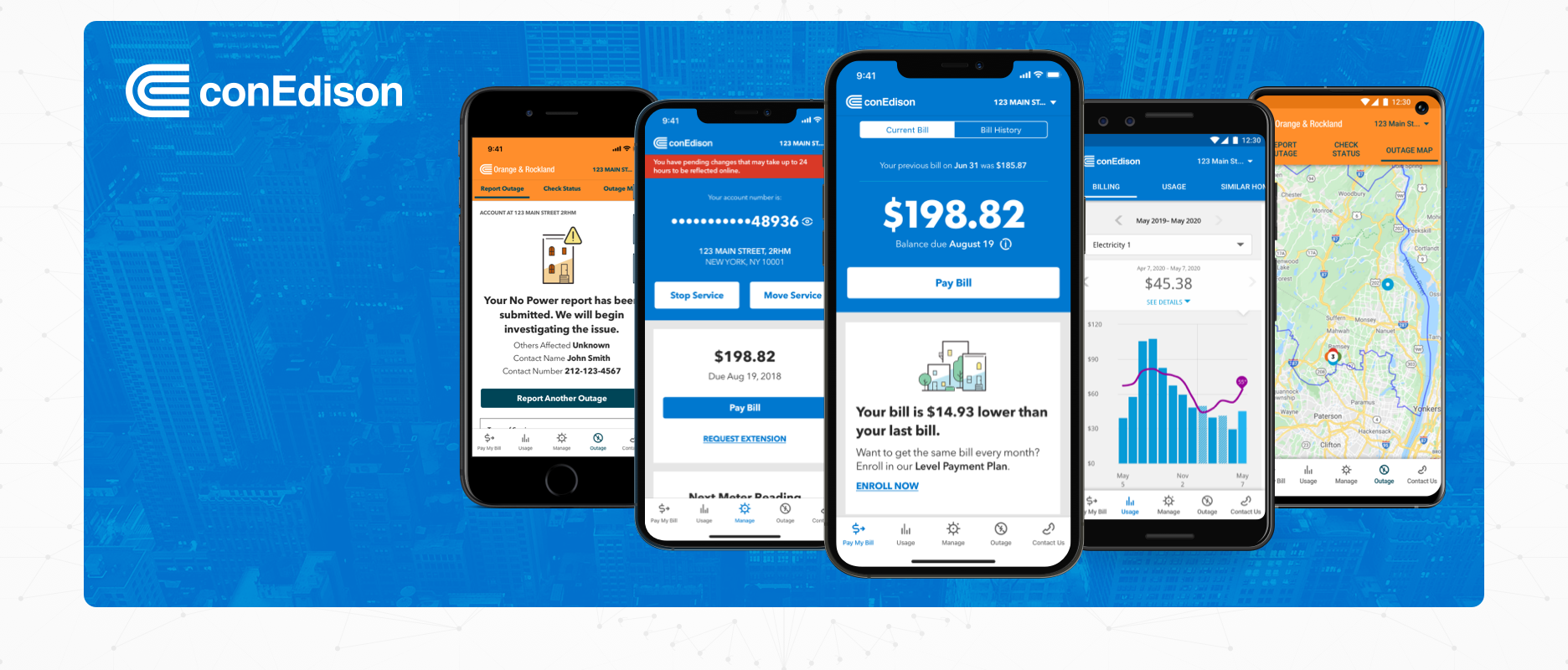
Con Edison needed native mobile apps that could make essential utility tasks feel simple under real-world pressure. I helped define the iOS and Android experience from the ground up, extend the system across the Orange & Rockland sister brand, and evolve the product through years of service, accessibility, payment, outage, and account-management enhancements.
During a broader redesign and rebrand of Con Edison's collateral and web properties, our team had the opportunity to demonstrate the value of dedicated mobile apps for utility customers. Once that value was clear, the work expanded into designing iOS and Android apps not only for Con Edison, but also for Orange & Rockland.
Utility design is unforgiving because people often arrive with a problem. They may have a bill to pay, a service address to manage, an outage to report, a payment agreement to understand, a meter issue to resolve, or an urgent need for help. The app had to support those moments in a regulated environment, across two brands, on two platforms, for a broad customer base that could not be expected to learn a complicated product.
The harder challenge was that the app could not stay frozen after launch. The product needed to absorb new operational needs over time, including bill comparison, high-demand alerts, third-party access, app ratings, assistance programs, transfer-service messaging, COVID payment agreements, and accessibility updates that touched both interaction logic and visual standards.
We began with a collaborative kickoff, onboarding, and a focused series of workshops to clarify requirements, identify MVP features, and ask hard questions about regulations and service capabilities. With the guardrails in place, we shaped the experience around the customer's most important needs: paying bills, reviewing usage, managing service, reporting outages, and contacting support.
Because the app was being designed from scratch, it was critical to test the approach with a wide range of customers on their preferred devices. We conducted a week of user testing and reporting, adjusting the platform experiences after each day of sessions while the evidence was still fresh. Once the navigation and flow approach was approved, UI standards were applied across the full app experience and interactive style guides were created for both the client and development teams.
The first product foundation covered a deep mobile service model: Pay My Bill, Usage, Manage, Outage, Contact Us, account selection, bill history, payment methods, payment assistance, stop and transfer service, request extension, meter reading, communication preferences, change password, paperless eBill, direct payment, level payment, outage reporting, outage status, outage maps, app icons, app store assets, and Orange & Rockland brand variants.
From there, the work kept expanding. We mapped the outage journey through customer interviews, user testing, and analytics review, then translated those findings into simplified flows, clearer language, outage estimation concepts, and smart-banner recommendations. We also designed follow-on improvements for bill comparison, notification management, third-party access, payment agreements, restricted multi-pay, assistance programs, transfer-service messaging, app rating prompts, COVID payment agreements, and What's New messaging across Con Edison and Orange & Rockland.
The app became more than a launch deliverable. It became a durable service platform that could support a sister-brand rollout, absorb new customer-care capabilities, and keep improving as expectations matured. Since the initial release, the product continued to support new features and services, giving Con Edison and Orange & Rockland customers a faster and simpler way to manage essential utility tasks.
In later evolutions, the product also moved toward stronger accessibility through color-logic updates, accessible icons, clearer informational display boxes, progress indication, tap-spacing refinements, field labeling improvements, screen-reading support, and platform-specific interaction guidance. Those improvements worked because the underlying product structure was strong enough to keep evolving without turning every new need into a one-off pattern.
The strongest part of the work is the way the product matured. The early app design established the service foundation, the Orange & Rockland rollout proved the system could travel, the outage journey work used research to expose where customers felt unheard or confused, and the accessibility work pushed the product toward clearer, more inclusive utility service.
There is something particularly satisfying about utility design when it is done well. The best version of the work does not call attention to itself. It makes stressful, necessary tasks feel quieter, clearer, and more dependable. That kind of practical usefulness is easy to underestimate, but it is exactly where strong product design earns its keep.
94 PDF Source Artifacts
Synthesized Con Edison documentation into the initial briefing materials that shaped work planning across app foundations, journeys, accessibility, payments, CSR flows, and service enhancements
2 Brands
Extended the mobile service model across Con Edison and Orange & Rockland, preserving shared product logic while adapting navigation, content, photography, and brand expression
2 Native Platforms
Designed iOS and Android experiences for the core utility app, including platform-specific navigation, interaction behavior, app assets, and native service flows
5 Primary Service Tabs
Structured the product around Pay My Bill, Usage, Manage, Outage, and Contact Us so customers could move quickly between the highest-value utility tasks
Full Account-Service Depth
Covered bill payment, bill history, usage graphs, similar-home comparisons, energy snapshots, service transfer, stop service, meter reading, request extensions, communication preferences, and bill settings
Outage Journey Improvement
Mapped the outage experience through customer interviews, user testing, and analytics review, identifying simplified flow, clearer language, outage estimation, and smart banners as priority opportunities
Lower Operational Friction
Recommended outage-flow changes that could reduce call-center volume, simplify analytics tagging, lower future maintenance cost, and make new feature additions easier to implement
Accessibility Evolution
Advanced the product through voice-over auditing, color replacement guides, accessible icon treatment, progress indicators, tap-spacing updates, screen-reading considerations, and larger interaction adjustments across both brands
Payment Resilience
Designed standard, modified, ineligible, down-payment, default, service-error, restricted multi-pay, and COVID payment-agreement flows so high-stakes payment moments had clearer paths and recovery states
Lifecycle Product Growth
Supported years of post-launch expansion across bill comparison, high-demand alerts, third-party access, app ratings, assistance programs, transfer-service messaging, What's New notifications, and commercial COVID payment agreements